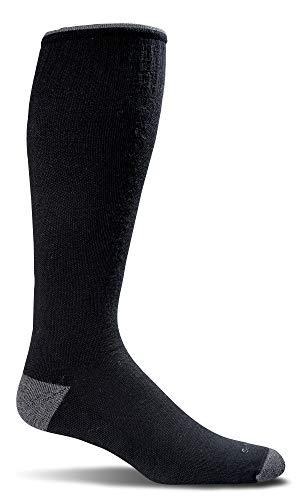
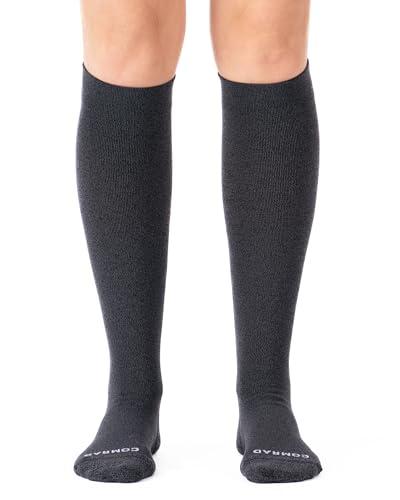
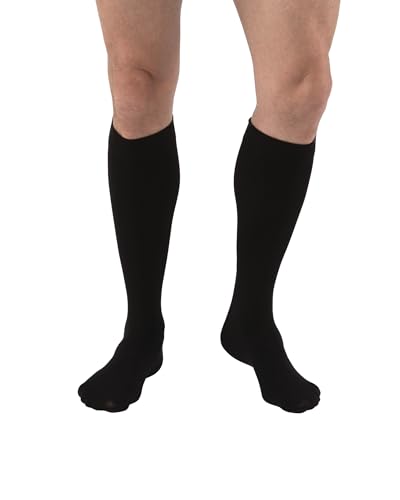
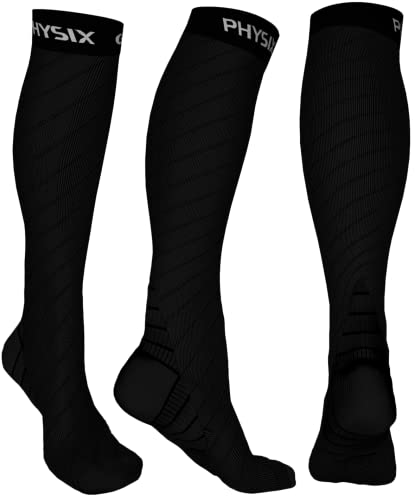
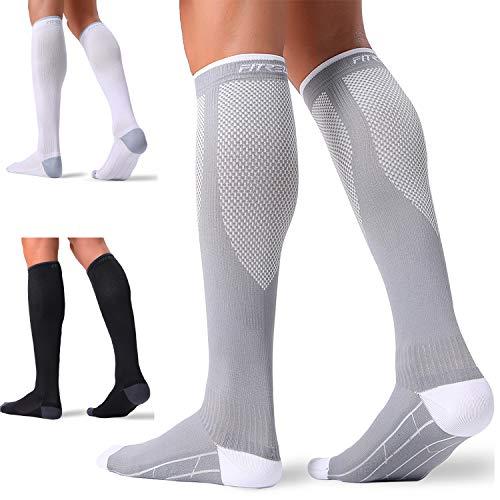
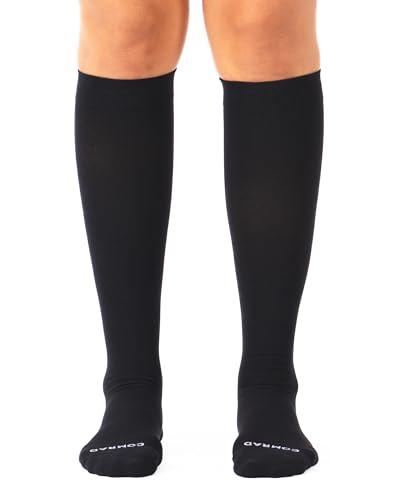
Start here. The Comrad 20-30 mmHg knee-high is the pick for most people, and it wins on information rather than fabric: it is the only brand in this registry that publishes a calf circumference range for every size and a stated threshold for when to size wide - and fit is what decides whether a compression sock does anything at all. It is for anyone who does not already know that their calf fits a standard sock. The budget pick is the FITRELL three-pair 20-30 mmHg multipack, because compression socks have to be rotated and one pair is not a system. Everything on this page returned a live price under the fifty-dollar line at our most recent check.
Nothing here is medical advice, nobody on this site has examined your legs, and new or worsening leg swelling is a clinical question rather than a shopping one. If a clinician has specified a compression level for you, that number wins over anything on this page.
The finding: this band is the whole category
Most under-$N pages exist because a price band contains a subset of the market. This one is different, and saying so is more useful than pretending otherwise: every compression sock in this registry priced under fifty dollars at our last check - seven out of seven. There is no premium tier above the line waiting for you.
So the real question is not “what can I get under fifty”, it is where between a twelve-dollar multipack and a forty-dollar pair should I be sitting? There are exactly three things the extra money buys, and knowing which of them you need is the entire decision:
- Published calf measurements. One brand here gives you a circumference range per size and a wide-calf threshold. Everyone else sizes by shoe size, which is a proxy for the wrong body part.
- Merino, for odor. A closed clog for twelve hours is the specific situation where a synthetic compression sock lets you down and wool does not.
- A gradient a clinic will stand behind. If compression was advised rather than chosen, a clinical manufacturer sized by leg measurement is a different product from a lifestyle sock at the same mmHg.
If none of those three applies to you, buy the multipack. That is a genuine recommendation, not a consolation prize.
Measure your calf before you read any further
This is the single highest-value thing on the page. A compression sock in the wrong circumference either rolls down over the course of a shift - at which point it is doing nothing - or digs a band into your calf, which is uncomfortable and also defeats the graduated gradient the sock is built around.
Measure the widest point of your calf, in the morning, before your legs have swollen. Then buy against a published range rather than a shoe size. Only one brand on this page lets you do that, and its stated rule is simple: over 17 in, choose a wide-calf option. If you are near or over that number, our wide-calf page is the one to read instead of this one - it is organized entirely around that measurement and carries the full method.
Pick the pressure before you pick the sock
The mmHg number matters more than the brand, and getting it wrong is how people conclude they hate compression socks.
15-20 mmHg - moderate, and where most people should start
Prevention level. It is for aching, end-of-shift heaviness and general tiredness, and critically it is the level you can actually get on at 06:30. A sock you fight and give up on helps nobody.
20-30 mmHg - firm, for established swelling
This is the level for visible swelling, varicose veins and anything a clinician has actually flagged. It is harder to put on and that is the barrier nobody warns you about. Starting here, unprompted, is the commonest reason people abandon compression entirely. Compression levels explained goes through the whole scale properly, and our 20-30 mmHg page is the pressure-led version of this list.
Do not buy down a level because it is easier
If you have been told 20-30, buying 15-20 because it pulls on more easily is the one mistake on this page that actually matters. That is a conversation with the person who told you, not a shopping decision.
Why one pair is not a purchase
Compression is a mechanical property of the knit, and it degrades with washing. A sock worn two days running is doing less on the second day, and a sock washed two hundred times is doing less than one washed twenty.
So the realistic unit of purchase in this category is three pairs, not one - which changes the money completely. Three premium merino pairs is a serious amount of money; three pairs from a multipack is not. That is the argument for the budget pick, and it is also the argument for the sensible hybrid a lot of people land on: one good pair to establish that the fit and pressure are right, then a multipack in the size you proved.
Nylon or merino, decided by your shoe
This is a smaller decision than fit and a bigger one than brand. A nylon compression sock launders easily, holds its compression well and is the cheaper route. A merino blend manages odor in a way synthetic fiber does not, which matters precisely because nursing shoes are closed, warm and worn for twelve hours.
The practical rule: if your feet sweat heavily and you wear a closed clog, pay for the merino. If you wear a mesh sneaker and your feet stay dry, the nylon sock is the better value and you lose nothing. Closed and waterproof shoes are the ones that make this decision for you, and do compression socks help nurses is worth reading first if you are not yet convinced the whole category is for you.
How these six were chosen
- It priced under the line on a live feed. All seven registry compression socks qualified at the most recent refresh; the six here are the ones with distinct jobs, and the seventh is a moderate-level merino pair covered on our other pages.
- It is buyable right now. The same feed is the availability check - no live offer, no price, no place on a page.
- Published sizing information was scored as a feature. Calf circumference ranges are the most useful thing a compression brand can publish, and the ranking above reflects that more than it reflects fabric.
- Fiber transparency was scored, and its absence noted. Two picks here do not publish a composition at all, and their entries say so.
- No testing, no clinical claims and no awards. We have not worn these for a shift and we are not a clinical source - how we pick states exactly what the scores are.
Which one, by situation
You have never worn compression: a single 15-20 mmHg pair, in a published calf size. Then a multipack once you know it fits.
Your ankles are visibly swollen at the end of a shift: firm 20-30 mmHg - and swollen feet after a shift covers the non-sock half, which matters too.
Your calf is over 17 in: wide-calf, from the one brand that publishes the threshold. See the wide-calf page first.
Your feet sweat and your shoes are closed: the merino blend. This is the one case where the premium pair is straightforwardly worth it.
A clinician advised compression: the clinical brand, sized by leg measurement, at the level you were given.
You are buying for a man’s leg: our men’s page covers the calf-shape differences that change the sizing answer, and best compression socks for standing all day is the use-led version of this list.