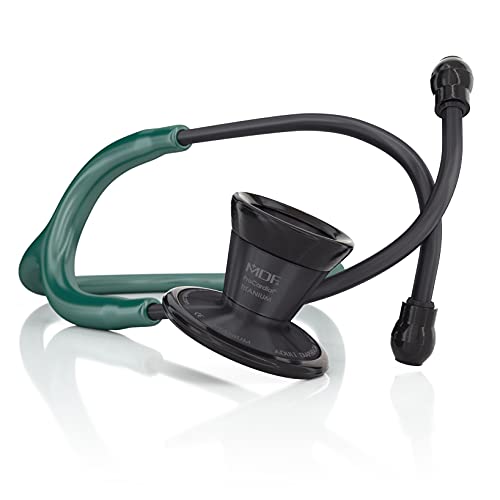
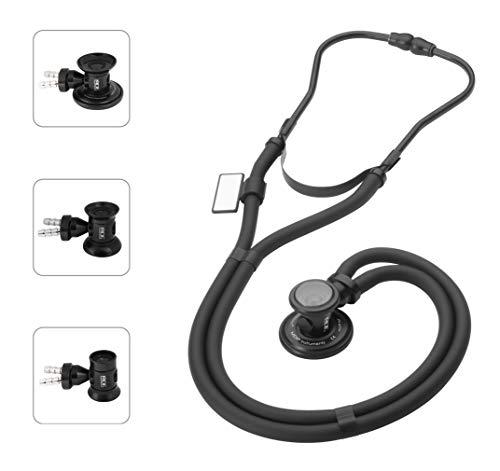
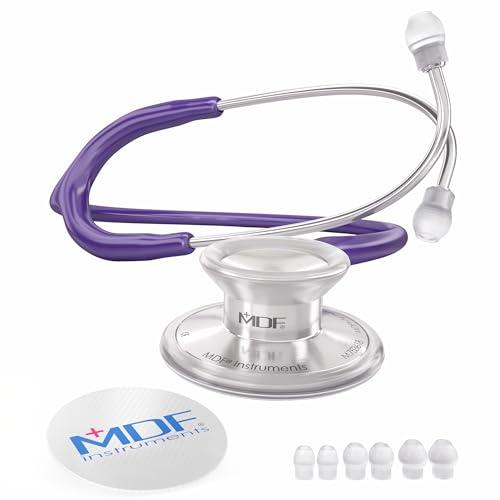
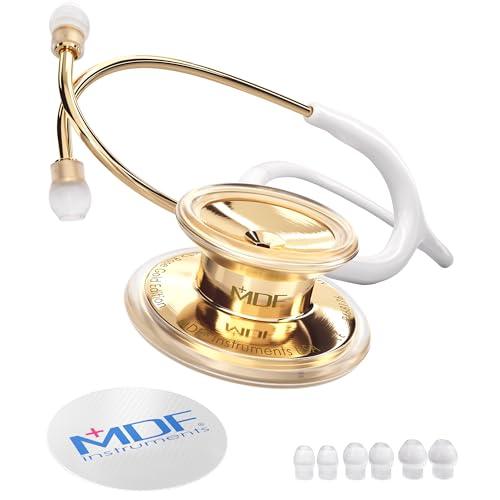
Start here. The MD One is the MDF most people should buy - stainless steel, separate bell and diaphragm, and roughly half a Littmann Classic III at MDF's own published prices. The ProCardial Titanium is the pick if you listen for murmurs daily, and our budget pick is the Acoustica, which is the cheapest instrument on this site that still carries a lifetime warranty. Before you choose a finish, read the warranty section below: the lifetime claim has one documented exception, and it is the kind of thing nobody notices until they need it.
The problem with ranking MDF, stated honestly
Our Littmann page is able to rank that range using 3M's own words, because 3M publishes a setting-by-setting position for every model - the Classic III is described as high acoustic sensitivity intended for non-critical-care settings, the Cardiology IV is stated to help isolate subtle sounds, the Lightweight II is positioned as an entry-level instrument with reliable acoustic performance. Whatever you think of marketing language, it is a published hierarchy you can hold the company to.
MDF publishes no acoustic tier at all. Not a sensitivity claim, not a frequency range, not an ordering of its own models by what they are for. That is a real gap and it changes how this page can work: there is no honest way to tell you that one MDF is acoustically better than another, because the manufacturer has not said so and we have not put four instruments through a measured comparison.
So the ranking above is built on what MDF does publish, and on what a buyer can verify before paying:
- Chestpiece construction. Every MDF model except the Singularis uses a separate bell and diaphragm rather than one tunable head.
- Body material. Stainless steel on the MD One, titanium on the ProCardial, aluminum on the Acoustica. Material drives weight, and weight is what you feel at hour ten.
- Configuration. Single-lumen dual-head, twin-tube Sprague Rappaport, or interchangeable chestpieces across chest sizes.
- Warranty terms, including the exception. See below - this is the one that costs people money.
If an acoustic tier is what you are shopping on, that is a legitimate reason to buy the other brand, and Littmann against MDF is the page that takes that argument apart properly.
The warranty is the product - and it has an exception
MDF states a lifetime warranty on its stethoscopes, and that is the single biggest structural difference between this range and the Littmann range, where most Classic III listings carry five years and one UK retailer states seven. MDF also replaces parts under the term, which is why these instruments survive units that chew through equipment: a lost eartip or a split diaphragm rim is a claim rather than a new purchase.
Here is the part to read before you pick a color. MDF's Mprint finishes carry separate warranty terms, so the lifetime claim is not universal across the range. The printed and patterned finishes are the most visible thing in MDF's catalog and they are the ones where the headline term does not simply apply. If the warranty is why you are buying MDF - and on this page it is the main reason - confirm the term on the exact finish in your cart rather than on the brand's general warranty page.
Separate bell and diaphragm, versus a tunable head
This is the design argument between the two brands and it is worth understanding before you spend anything, because it is not a quality difference - it is a different answer to the same problem.
A tunable diaphragm uses pressure to change what you hear: rest it lightly for low frequencies, press firmly for high ones, one surface doing both jobs. A separate bell and diaphragm splits those jobs across two physical surfaces and asks you to flip the chestpiece. The tunable head is faster in practice and it is why the Littmann range is laid out the way it is. The split head removes the thing that goes wrong with tunable diaphragms, which is applying the wrong pressure without realizing it and concluding you cannot hear a sound that is there.
Neither is correct in general. Both are correct for someone. If you learned on a tunable head and are fluent with it, switching to MDF means re-learning a physical habit in the middle of your shifts, and that is a real cost that no spec sheet shows.
Which MDF, by job
- Floor nursing, med-surg, telemetry. MD One. Stainless, split head, lifetime term, half the money of the obvious alternative.
- Daily murmur work. ProCardial Titanium, with the finish caveat above - and check what your service expects to see around your neck before you buy a patterned one.
- Mixed adult, pediatric and infant caseload. Sprague Rappaport, for the interchangeable chestpieces, accepting the tube-rub noise as the price.
- Clinical rotations or a loss-prone unit. Acoustica. Cheap enough to lose, warranted for life anyway.
- ICU and critical care. Be careful here. None of the four has a published acoustic claim to stand on, and this is the setting where that matters most. Our ICU page works through why, and what we recommend instead.
How these four were chosen
- Published facts only, from MDF itself. Every claim above - the lifetime term, the Mprint exception, the separate bell and diaphragm, the material of each chestpiece, the published list ranges - comes from MDF's own stethoscope collection, cited at the bottom of this page. Where MDF publishes nothing, this page says so rather than filling the gap.
- No invented acoustic ranking. The order above is a construction and use-case order. Nobody on this site has put these four instruments through a measured acoustic comparison, and we are not going to imply otherwise.
- Currently purchasable, checked against our live feed. All four returned a buyable offer at the most recent price refresh, which is also why all four are on the page.
- Honest cons on every pick. One of the four has a documented noise problem, one has a finish range half the hospitals in the country will not accept, and one should not still be in your pocket in year three. All of that is above.
- No price written into the prose. Every price on this site is read live when the page loads. Comparisons here are MDF's own published list relationships, not a number we typed in.
What MDF does not sell you
Three things, and they are the honest reasons to buy elsewhere. There is no digital or amplifying instrument in this range, so if you have genuine hearing loss the answer is a different brand entirely - our hard-of-hearing page covers the small field that actually qualifies. There is no published acoustic hierarchy, as above. And there is no ubiquity: in most units the instrument on the next person's neck is a Littmann, which means spare parts, borrowed eartips and the familiarity of handing your scope to a colleague all tilt the other way.
If you are weighing an MDF against a specific Littmann rather than against the brand, Cardiology IV against the ProCardial is the head-to-head, and Littmann alternatives maps each Littmann model to its nearest replacement across brands. If your decision is really about budget rather than brand, best stethoscopes under $100 is the mixed-brand field inside that band, and three of the four instruments on this page are in it.
And if you are at the start of this decision rather than the end, how to choose a stethoscope goes through what the tiers mean, which specs predict the experience and which do not.