Skip to content
Shift & Sole

Buying guide · Stethoscopes

Littmann Alternatives

The alternative list in this category is short and honest. Here is which instrument replaces which Littmann, what it keeps, and what no substitute gives you back.

By Selena H.
A dual-head stethoscope coiled on a countertop beside a folded scrub top

The shortlist

Quick picks

Tap any row to jump to that pick’s full write-up. The price column goes straight to Amazon.

Ranked comparison of our picks, with what each one is best for and our overall score
#ProductBest forScorePrice
1
MDF MD One Stainless Steel Adult product photo

MDF MD One Stainless Steel Adult

The direct substitute for the default nurse stethoscope: stainless chestpiece, separate bell and diaphragm, and a lifetime warranty instead of a five-year one.

Replacing a Classic III - the one-instrument floor stethoscope8.7/ 10
$69.99 · View on Amazon

$89.99 · 22% off

2
MDF ProCardial Titanium Cardiology product photo

MDF ProCardial Titanium Cardiology

A titanium cardiology chestpiece under a lifetime warranty, which no Littmann cardiology model offers at any price.

Replacing a Cardiology IV - and the lightest cardiology chestpiece here8.4/ 10
$118.99 · View on Amazon

$139.99 · 15% off

3
MDF Acoustica Lightweight product photo

MDF Acoustica Lightweight

Our budget pick, and the only cheap instrument here that still carries a lifetime warranty - a combination that does not otherwise exist.

The budget pick: a first clinical rotation, or a unit where equipment disappears8.0/ 10
$23.79 · View on Amazon

$29.99 · 21% off

4
MDF Sprague Rappaport product photo

MDF Sprague Rappaport

The genuinely different design here: twin-tube, interchangeable chestpieces, and the one alternative that is not just a cheaper version of a Littmann.

Covering adult, pediatric and infant work with one instrument7.7/ 10

Scores are our own editorial assessment of how well each product suits the job on this page. They are not a product rating from reviews and not the result of testing - we have not worn or used these. Prices come from Amazon and were last checked November 28, 2026; a button with no number means Amazon showed no live price at that check, so tap it for the current one. #ad

3M Littmann is the default for reasons that hold up. The Classic III’s tunable diaphragms let you change frequency range by changing hand pressure instead of re-seating the chestpiece on a patient; 3M publishes a real spec sheet, states that the tubing is not made with natural rubber latex or phthalate plasticizers, and voluntarily narrows its own market by describing the Classic III as being for non-critical settings; and the parts ecosystem is genuinely a feature - eartips and binaural assemblies are stocked everywhere, and a colleague can almost always help you troubleshoot one. So an honest alternatives page has to start by admitting the list is short - and by saying what the alternative actually buys you, because it is not better acoustics.

Why people look for an alternative

  • Price. A Classic III is a meaningful amount of money for a student, and a Cardiology IV is roughly double it again.
  • Theft and loss. This is the most under-rated reason on the list. On a floor where equipment disappears, the expensive popular instrument is the wrong purchase, and no amount of engraving changes the arithmetic.
  • Warranty. Most Littmann listings state five years; one UK retailer states seven, and we could not resolve that against a current manufacturer warranty page. MDF publishes a lifetime warranty. If you intend to own one instrument for a career, that difference is the whole argument.
  • You want a real open bell. A tunable diaphragm is a convenience feature, not a bell. If you specifically want a separate open bell as your primary low-frequency tool, every MDF model except the Singularis gives you one and the Classic III does not.

The acoustic comparison does not exist, and that matters here

3M does not publish a numeric acoustic tier for the Classic III. MDF publishes none at all for any of its instruments. Anyone quoting you a tier number for a Littmann is quoting a third party, not a manufacturer, and our page on where the published specs disagree lists the other places this happens.

The practical consequence is that nobody - including us - can show you a figure proving an MDF sounds the same as, or worse than, a Littmann. So this page compares what is published: warranty terms, chestpiece construction, materials, weight, parts programs and price position. Any page that tells you a cheaper stethoscope is "95% as good acoustically" is inventing that number.

Why the list is four instruments from one brand

Because padding it would be dishonest. The US nurse market has one widely-stocked alternative brand that publishes model numbers, a named warranty and a parts program, and that is MDF Instruments. The rest of the cheap end of the category is unbranded generics: no model number that means anything, no published warranty, specs that disagree between listings of the same item, and no way to get a replacement diaphragm in two years. That is not an alternative, it is a gamble with a stethoscope shape.

So the four picks above are the four MDF instruments that map onto the four Littmanns people actually buy. Our criteria, in order:

  1. It replaces a specific Littmann. Each entry names the model it stands in for. "Also a stethoscope" is not a qualification.
  2. The manufacturer publishes a warranty term. This is the single criterion that eliminates the generic end of the category outright.
  3. Replacement parts are obtainable. A stethoscope is a ten-year purchase or a disposable one, and which it is depends entirely on whether you can buy a diaphragm for it later.
  4. Currently sold in the US. Availability was re-checked for every pick when this page was written.
  5. Honest cons on every pick, including the one ranked first.

Nobody here has listened through any of these instruments. This is a research site and we say so on every page; the scores above read published specifications and aggregate owner feedback, not a listening test.

The replacement map

Find the Littmann you were going to buy.

Classic III → MDF MD One

The straight swap, and the one most people mean when they search for this. You keep a stainless steel dual-head instrument suitable for lung sounds, bowel sounds, blood pressures and routine heart sounds. You gain a lifetime warranty and a separate bell. You give up the tunable head and the hallway familiarity. If you want that argument in detail rather than as a summary, Littmann vs MDF is the head-to-head, and our Classic III review is what you would be walking away from.

Cardiology IV → MDF ProCardial Titanium

Same tier intent - an instrument aimed at subtle sounds - in titanium rather than stainless, which is lighter at the same chestpiece size. It is cheaper than a Cardiology IV at list and it carries the lifetime term. Check your unit’s appearance expectations first: the patterned and glitter finishes dominate MDF’s cardiology range. For the decision upstream of this, Classic III against Cardiology IV is whether you need a cardiology chestpiece at all.

Lightweight II S.E. → MDF Acoustica

Both are entry-level instruments and both manufacturers are honest about it - 3M’s own word for the Lightweight II is "reliable" rather than exceptional. The Acoustica is cheaper and carries the lifetime warranty. This is the right pair to compare if you are a student, and the student page argues the replaceability case properly.

Classic II Pediatric → MDF Sprague Rappaport

A sideways move rather than a swap. Buying a dedicated pediatric Littmann means owning two instruments, because a pediatric chestpiece is poor on an adult chest. The Sprague’s interchangeable chestpieces cover adult, pediatric and infant with one body. You pay for it in tube-on-tube noise and bulk. For a pediatric-specific purchase, the pediatric roundup is the page.

The fifth option: a cheaper Littmann

This belongs on an honest alternatives page even though it is not a different brand. If the only reason you are here is price, and what you actually value is the parts ecosystem and the hallway familiarity, the cheapest real Littmann - the Lightweight II S.E. - keeps all of that and costs a fraction of a Cardiology IV. You lose the tunable diaphragm and some build solidity.

We would rather point you at that than talk you into a brand switch you did not need, and the budget stethoscope page lays out both routes side by side. Buying the best legitimate option for your situation is the rule here even when it is the one we do not gain from.

Before you blame the brand

Three things decide how any stethoscope sounds to you, and two of them have nothing to do with which name is stamped on the chestpiece. Worth checking before you conclude that a cheaper instrument is the reason you cannot hear something.

The eartip seal. This is the biggest single variable and the cheapest to fix. An eartip that does not seal leaks the sound you are trying to hear and lets in the room instead, and a hardened eartip on an instrument that is two years old does not seal. Both manufacturers sell replacement tips in more than one size; most people have never tried the other size. If a stethoscope "went quiet," this is almost always what happened.

Tubing length. 27 to 28 inches is the standard, and longer tubing puts more distance between you and the patient and slightly more between you and the sound. 3M publishes 69 cm, about 27.2 in, for the Classic III and offers other lengths in the range. Buy by your own height rather than by a performance claim - too long and the chestpiece swings into bed rails, too short and you are bent over the mattress all shift.

The diaphragm, and whether you are using it. On a tunable head you change frequency range with hand pressure. Press hard through an entire assessment and you have effectively disabled the feature. On a separate bell and diaphragm - which is what every MDF model here gives you - you flip the chestpiece instead, which is slower but harder to get wrong.

None of this is an argument against switching. It is an argument for fixing the free problem first, and the accessories page covers what the replacement parts cost on both brands.

What no alternative gives you back

The colleague who can fix it. Littmann’s ubiquity has genuine practical value: when a diaphragm rim splits mid-shift, someone on your unit has a spare or knows where the box is. Nobody has a spare MDF part in their locker.

The documentation. 3M publishes spec sheets, product manuals and a feature breakdown as PDFs. MDF publishes a collection page and a comparison table. If you like being able to read the manufacturer’s own figures before you buy, that asymmetry is real and it is the strongest non-acoustic argument for staying.

Resale and handover value. A Littmann is recognizable enough to be worth something second-hand and to be worth handing to a student. An MDF, fairly or not, is not.

Three things to do if you switch

  1. Register the instrument. MDF names registration as the route to its lifetime warranty, lifetime calibration warranty and free-parts-for-life program. An unregistered lifetime warranty is a marketing line; a registered one is the reason to have switched at all.
  2. Check the finish, not just the model. MDF’s Mprint finishes carry separate warranty terms from the standard range. If the warranty is why you are buying, buy a finish that has it.
  3. Engrave it anyway. A lifetime warranty covers failure, not theft. Our accessories page covers name tags and ID options, and how to clean a stethoscope covers the routine that decides whether any of these lasts a decade.

Where to go next

If you have not decided what tier you need at all, how to choose a stethoscope is the upstream page and the main stethoscope roundup is where to start. For the wider brand landscape beyond these two names, see stethoscope brands. The same brand-premium question runs through the rest of the site, worked the same way, on Dansko alternatives and FIGS alternatives.

If you decide to stay with Littmann after all, our Littmann range page ranks the five models against each other on 3M’s own positioning rather than on price, and it is clear about which upgrade is audible and which is not.

The picks in full

Every pick, in order

01

Replacing a Classic III - the one-instrument floor stethoscope

MDF MD One Stainless Steel Adult

The direct substitute for the default nurse stethoscope: stainless chestpiece, separate bell and diaphragm, and a lifetime warranty instead of a five-year one.

MDF MD One Stainless Steel Adult product photo

Dual-head stainless steel stethoscope

Chestpiece
Separate bell and diaphragm (all MDF models except Singularis)
Warranty
MDF states a lifetime warranty on its stethoscopes
Material
Stainless steel chestpiece
MDF list pricing
Published as a range by finish

Specs: MDF Instruments - stethoscopes collection

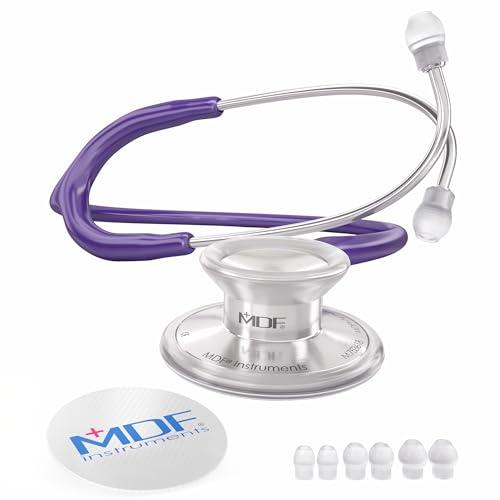
If you were going to buy a Classic III and changed your mind, this is where you land. It is a stainless steel dual-head instrument at roughly half a Classic III at MDF's own prices, and the warranty is the headline: MDF publishes a lifetime warranty with a free-parts-for-life program across its stethoscope range, where most Littmann listings state five years. The construction difference is real rather than cosmetic - a separate bell and diaphragm instead of a tunable head, so you change frequency range by flipping the chestpiece rather than by changing hand pressure. Two honest costs: MDF publishes no acoustic performance tier at all, so a paper comparison against a Littmann is not possible in either direction, and its Mprint finishes carry different warranty terms, so the lifetime claim is not universal across the range.

Routine assessment8.8
Warranty and parts program9.8
Build quality8.6
Published spec quality5.5
Colleague familiarity5.0
Overall8.7 / 10

What it gets right

  • A lifetime warranty against a five-year one is the single biggest difference between MDF and Littmann, and it is MDF's own published term
  • Separate bell and diaphragm, so you are not relying on a tunable head to do both jobs
  • Roughly half a Classic III at MDF's own prices
  • MDF replaces parts under the warranty, which is why these survive units that destroy equipment

What it gets wrong

  • MDF publishes no acoustic performance tier at all, so comparing it to a Littmann on paper is not possible
  • Mprint finishes carry separate warranty terms - the lifetime claim is not universal across the range
  • Less familiar to colleagues, so troubleshooting help is thinner
  • Heavier than a Lightweight II

Who should skip itYou want the instrument everyone around you already knows. Littmann's ubiquity has real practical value when something breaks mid-shift.

$69.99 · View on Amazon

$89.99 · 22% off

#ad How we earn · price as of November 28, 2026

02

Replacing a Cardiology IV - and the lightest cardiology chestpiece here

MDF ProCardial Titanium Cardiology

A titanium cardiology chestpiece under a lifetime warranty, which no Littmann cardiology model offers at any price.

MDF ProCardial Titanium Cardiology product photo

Titanium cardiology stethoscope

Chestpiece
Titanium, cardiology-focused per MDF
MDF list pricing
Published as a range by finish
Warranty
MDF states a lifetime warranty on its stethoscopes
Construction
Separate bell and diaphragm

Specs: MDF Instruments - stethoscopes collection

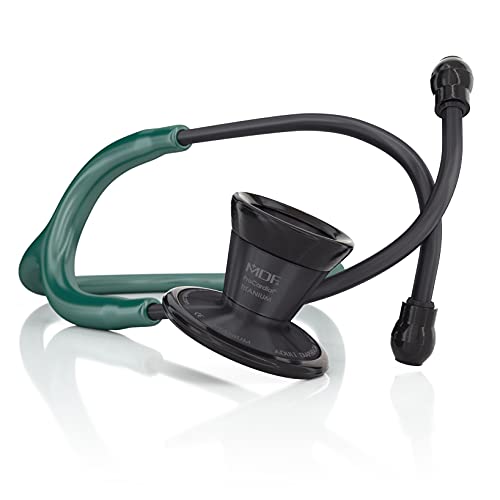
This is the pick for a step-down unit or a cardiac floor where you want the heavier chestpiece but not the Littmann cardiology price. Titanium is lighter than stainless at the same size, which you notice across twelve hours of carrying it, and MDF's lifetime term applies here as it does across the range - 3M does not offer a lifetime warranty on any cardiology model. It is also cheaper than a Cardiology IV at MDF's own list price. The same caveat applies as everywhere in this category: there is no published acoustic tier on either side, so nobody can show you a number proving the swap is acoustically equal. The glitter and pattern finishes also dominate the range, which some units will not accept, and those Mprint finishes have their own warranty terms.

Cardiology intent8.8
Warranty and parts program9.8
Weight around the neck9.2
Published spec quality5.5
Colleague familiarity4.5
Overall8.4 / 10

What it gets right

  • A titanium cardiology chestpiece under a lifetime warranty, which no Littmann cardiology model offers
  • Titanium is lighter than stainless at the same size, and you notice over twelve hours
  • Cheaper than a Cardiology IV at MDF's own list price

What it gets wrong

  • No published acoustic tier, so there is no paper comparison against the Littmann cardiology line
  • The glitter and pattern finishes dominate the range, which some units will not accept
  • Mprint finish warranty terms differ from the standard lifetime claim

Who should skip itYou need to match what your attending or preceptor uses. In cardiology specifically, being able to hand your scope over and have it feel familiar has practical value.

$118.99 · View on Amazon

$139.99 · 15% off

#ad How we earn · price as of November 28, 2026

03

The budget pick: a first clinical rotation, or a unit where equipment disappears

MDF Acoustica Lightweight

Our budget pick, and the only cheap instrument here that still carries a lifetime warranty - a combination that does not otherwise exist.

MDF Acoustica Lightweight product photo

Lightweight dual-head stethoscope

MDF list pricing
Published, and the lowest in MDF's range
Warranty
MDF states a lifetime warranty on its stethoscopes
Construction
Separate bell and diaphragm
Build
Lightweight aluminum-bodied range

Specs: MDF Instruments - stethoscopes collection

This is the budget pick and the right answer to a specific problem: a floor where stethoscopes walk off. The Classic III is popular enough to be worth stealing, and the correct purchase on that unit is an instrument you can replace without flinching. The Acoustica is the cheapest thing on this site that still carries MDF's lifetime warranty, and it is light enough to forget around your neck. Be clear on what it is not. The acoustics are entry-level and MDF publishes no tier to argue otherwise, the aluminum body feels cheap next to stainless, and this is not an instrument to still be using in year three. If you are past your student rotations and buying one scope to keep, the MD One is the better spend.

Replaceability9.8
Warranty and parts program9.6
Weight around the neck9.6
Routine assessment6.4
Build quality5.8
Overall8.0 / 10

What it gets right

  • The cheapest instrument on this site that still carries a lifetime warranty - that combination does not exist anywhere else
  • Light enough that you forget it is around your neck
  • The right answer for a first clinical rotation where theft and loss are the real risks

What it gets wrong

  • Entry-level acoustics, and MDF publishes no tier to argue otherwise
  • Aluminum body feels cheap next to stainless
  • Not an instrument to still be using in year three

Who should skip itYou are past your student rotations. An Acoustica is a good first stethoscope and a frustrating fifth-year one.

$23.79 · View on Amazon

$29.99 · 21% off

#ad How we earn · price as of November 28, 2026

04

Covering adult, pediatric and infant work with one instrument

MDF Sprague Rappaport

The genuinely different design here: twin-tube, interchangeable chestpieces, and the one alternative that is not just a cheaper version of a Littmann.

MDF Sprague Rappaport product photo

Dual-tube Sprague Rappaport stethoscope

MDF list pricing
Published as a range, with the Sprague-X above the standard model
Warranty
MDF states a lifetime warranty on its stethoscopes
Design
Twin-tube Sprague Rappaport configuration
Accessories
Interchangeable chestpieces and bells in the range

Specs: MDF Instruments - stethoscopes collection

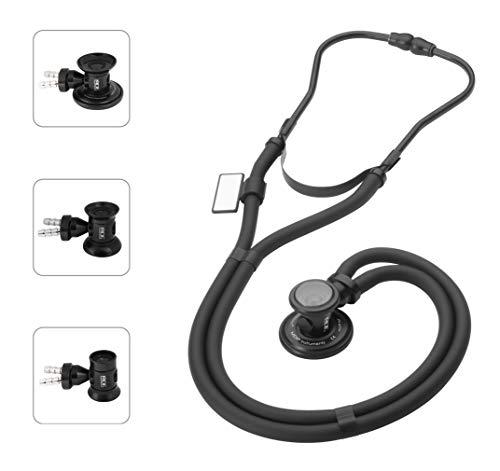
Pick this if your patient population spans sizes. The interchangeable chestpieces and bells mean one instrument covers adult, pediatric and infant work, which otherwise means owning a second stethoscope - the Littmann answer to that is a separate Classic II Pediatric, because a pediatric chestpiece is a poor instrument on an adult chest. The twin-tube Sprague Rappaport configuration is also a different acoustic approach rather than a styling choice. The cost is the classic complaint about the design and it is not solvable by careful handling: the two tubes rub against each other and that friction goes straight into your ears. It is bulkier around your neck than a single-lumen scope, and there are more small parts to lose.

Patient-size coverage9.5
Warranty and parts program9.6
Routine assessment7.6
Quietness4.0
Bulk around the neck4.5
Overall7.7 / 10

What it gets right

  • Interchangeable chestpieces mean one instrument covers adult, pediatric and infant work
  • The twin-tube design is a genuinely different acoustic approach, not a styling choice
  • Lifetime warranty at a low price point

What it gets wrong

  • Twin tubes rub against each other and that friction is audible - it is the classic complaint about this design
  • Bulkier around the neck than a single-lumen scope
  • Multiple small parts to lose

Who should skip itYou want quiet. Dual-tube designs transmit tube-on-tube rubbing straight into your ears, and no amount of careful handling eliminates it.

$39.99 · View on Amazon

#ad How we earn · price as of November 28, 2026

FAQ

Questions people actually ask

What stethoscope is similar to a Littmann?

MDF Instruments is the alternative brand with real US distribution, published model numbers and a named warranty. The MD One is the closest analogue to a Classic III - a stainless steel dual-head instrument for routine assessment - and the ProCardial Titanium stands in for a Cardiology IV. The construction differs in one visible way: MDF uses a separate bell and diaphragm rather than a tunable head.

Is an MDF stethoscope as good as a Littmann?

Nobody can answer that with a number, and you should distrust any page that tries. 3M publishes no numeric acoustic tier for the Classic III and MDF publishes none at all, so there is no comparable figure in either direction. What is published favors MDF on warranty and price and Littmann on documentation, parts availability and how familiar the instrument is to the people around you.

What is the cheapest alternative to a Littmann worth buying?

The MDF Acoustica, which is our budget pick - the cheapest instrument on this site that still carries MDF’s lifetime warranty. It is the right purchase for a first clinical rotation or a unit where stethoscopes disappear. It is not the right purchase if this is the one scope you intend to keep for years; the MD One is the better spend there.

Does MDF really offer a lifetime warranty?

MDF publishes a lifetime warranty, a lifetime calibration warranty and a free-parts-for-life program across its stethoscope range, with product registration named as the condition, plus a 90-day money-back guarantee. Two caveats: register the instrument, and check the finish - MDF’s Mprint finishes carry separate warranty terms, so the lifetime claim is not universal across every colorway.

Should I just buy a cheaper Littmann instead of switching brands?

Often, yes. If price is your only objection and you value the parts ecosystem, the Lightweight II S.E. is the cheapest real Littmann and keeps all of it. You give up the tunable diaphragm and some build solidity. Our budget stethoscope page compares both routes.

Why are there no other brands on this list?

Because the rest of the low-cost category is unbranded generics with no meaningful model number, no published warranty, specs that disagree between listings of the same item and no route to a replacement diaphragm in two years. We would rather name one credible alternative brand than pad a list with instruments we cannot verify.

How this page was put together

We start from the problem the gear has to solve over twelve hours, shortlist products that are currently sold, compare the manufacturers’ published specifications against what that problem actually needs, and read owner feedback at volume to find the failure modes worth reporting. We have not worn, used or physically tested any of this. Where a figure comes from a manufacturer we name them; where published figures disagree with each other we say so rather than picking the flattering one; where nobody publishes a figure we say that too. Prices are never typed into the page: they come from Amazon’s API with the date they were checked, and they expire on their own. Read the full method.