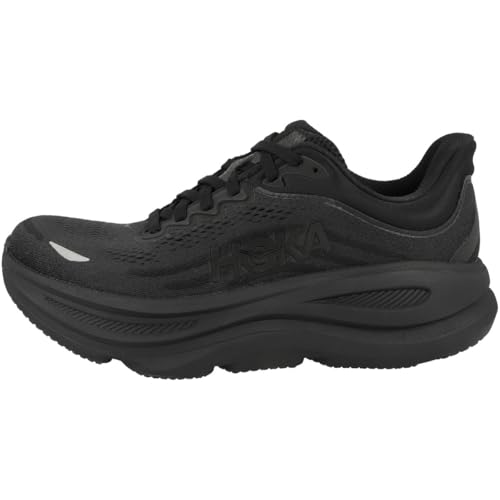
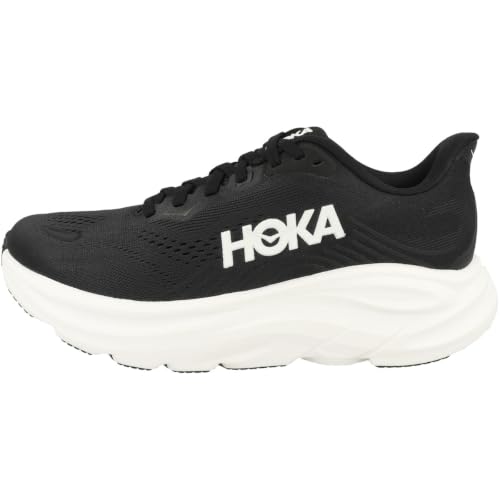
These two shoes are bought by the same person for the same reason, usually after a pair of cheap sneakers stopped working somewhere around month four. They share a brand, a rocker geometry, a mesh upper and a heel stack within a millimeter of each other. The decision between them comes down to one and a half ounces against four millimeters of forefoot foam, and which of those matters depends entirely on what hurts at the end of your shift.
What actually decides this, in order
Before the numbers, the criteria - because "more cushioning" is not a reason on its own and HOKA sells both of these as comfortable.
- Where the pain is. Ball-of-foot and forefoot pain points at the Bondi, which has four more listed millimeters under the forefoot. Heel and general fatigue is close to a tie, because the heel stacks are a millimeter apart.
- Weight, compounded. An ounce and a half per shoe is nothing in a store and noticeable at hour ten. If you have ever taken your shoes off at lunch, weight is your criterion.
- Width. The Bondi is published in more widths than the Clifton. If you need Wide or X-Wide, check stock in your colorway before anything else here matters.
- Whether your unit requires slip resistance. Neither of these is a rated work shoe. If your policy requires one, this whole comparison is the wrong page.
- What gets spilled on them. Both have knit mesh uppers. Neither wipes clean.
Side by side, listed and measured
Both columns carry two sets of numbers, because HOKA’s listed figures and RunRepeat’s calipers do not agree on either shoe - and they disagree in the same direction, which is informative in itself.
| Specification | Bondi 9 | Clifton 11 |
|---|
| Heel stack, listed | 43 mm | 42 mm men’s / 38 mm women’s |
| Heel stack, measured | 41.3 mm | 41.4 mm |
| Forefoot stack, listed | 38 mm | 34 mm men’s / 30 mm women’s |
| Forefoot stack, measured | 32.2 mm | 29.7 mm |
| Drop, listed | 5 mm | 8 mm |
| Drop, measured | 9.1 mm | 11.7 mm |
| Weight, listed | 10.5 oz men’s / 9.3 oz women’s | 9.1 oz men’s / 7.9 oz women’s |
| Weight, measured | 10.7 oz | 9.4 oz |
| Widths published | Narrow, Normal, Wide, X-Wide | Normal, Wide, X-Wide |
| Upper | Knit mesh, reflective, 9.0 mm tongue padding | Engineered mesh, softened in the 2026 update |
| Slip-resistance rating | None | None |
| Current generation | Yes - the Bondi 9 is the current Bondi | Yes - replaced the Clifton 10 in July 2026 |
| List price | The higher of the two | The lower of the two |
No price is typed into this page, because a number typed in October is wrong by December: every number sits inside a buy button, read from Amazon’s API on the date shown. What is stable is the relationship between the two, and the Bondi is consistently the pricier shoe.
The drop numbers are the thing nobody mentions
HOKA lists the Bondi 9 at a 5 mm drop. RunRepeat measured 9.1 mm. HOKA lists the Clifton 11 at 8 mm; RunRepeat measured 11.7 mm. In both cases the measured heel-to-toe difference is around 4 mm higher than the listed figure, which RunRepeat attributes to HOKA measuring further back on the midsole than the standard point.
If drop is a number you have been told to care about - by a podiatrist, a physical therapist, or an Achilles that has objected before - then buying either of these on the listed figure is buying the wrong shoe. The practical read: both measure as moderate-drop shoes, the Clifton measures as the higher-drop of the two, and the gap between them (about 2.6 mm measured) is roughly what the listed figures claim (3 mm). The ranking is right even though the absolute numbers are not.
Forefoot stack is the real difference
Heel to heel, these shoes are indistinguishable on paper: 41.3 mm against 41.4 mm measured. The gap is entirely in the front of the shoe, where the Bondi carries 32.2 mm against the Clifton’s 29.7 mm measured - and 38 mm against 34 mm listed.
Two and a half to four millimeters sounds like nothing. It is not nothing in the forefoot, because that is where the load sits on the second half of a shift, and it is the area most implicated in the ball-of-foot pain that sends people shoe shopping in the first place. If your complaint is burning or aching across the ball of the foot rather than general tiredness, the Bondi is the shoe that addresses it.
If the complaint is heel pain, the answer is different again and it is not either of these on their own - see the plantar fasciitis picks, where heel geometry and an insole do more than stack height.
Weight: the Clifton’s whole argument
Measured, the difference is 1.3 oz per shoe - 10.7 oz against 9.4 oz. HOKA’s listed figures put it at 1.4 oz. Either way it is somewhere between 12% and 14% of the shoe’s weight, lifted several thousand times across a shift.
The useful way to decide is to ask what happened the last time you wore a heavier shoe. People who describe the Bondi as feeling like a boot are not wrong - it is a tall, heavy, deliberately overbuilt shoe - and for those people the Clifton keeps nearly all of the heel cushioning at a weight they will actually tolerate. People who have never noticed shoe weight should take the forefoot foam instead.
Widths, and why they decide more than either number
RunRepeat lists the Bondi 9 in Narrow, Normal, Wide and X-Wide, and the Clifton 11 in Normal, Wide and X-Wide - with the caveat, published on HOKA’s own listings, that not every colorway exists in every width. In practice that means the width you need and the color you want are two constraints that often do not intersect.
A correctly cushioned shoe in the wrong width is worse than the alternative in the right one. If your feet are wide, start at the wide-feet roundup and treat this comparison as a tiebreaker rather than the decision.
What neither of these does
Both are running shoes doing a work-shoe job, and both fail in exactly the same two ways.
No slip-resistance rating. Neither shoe is tested or rated for a wet floor. If your unit’s policy requires a slip-resistant shoe - and plenty of ORs, EDs and dialysis units do - then the HOKA that qualifies is the Bondi SR, which is leather, slip-rated and about four ounces heavier again. It appears on the waterproof picks and it is also the footwear line on the ICU and ER kit list, where fluid on the floor is a planning assumption rather than an accident.
A mesh upper that cannot be wiped down. Knit mesh absorbs whatever lands on it and takes a day to dry. There is no version of either shoe that solves this; it is the material. If you get fluid on your feet with any regularity, buy a leather clog or a leather work shoe and keep the HOKAs for the commute. Clogs against sneakers is the page that argues this properly.
A note on generations, because it matters here
The Clifton 11 arrived in July 2026 and replaced the Clifton 10. The update was a softer engineered mesh upper and a more pliable sockliner - HOKA left the listed geometry alone, so the 42 mm / 34 mm stack and 8 mm drop carry over from the 10. That makes this an unusually safe version bump: if you liked the Clifton 10, the 11 is the same ride with a kinder upper.
It also means a discounted Clifton 10 is a legitimate buy rather than a compromise, which is not something we would say about most outgoing models. The one caveat is the generation before that - the Clifton 9 was 40 mm / 35 mm, a genuinely lower and flatter shoe - so a "Clifton" you liked three years ago is not the shoe either of these is.
The Bondi 9 remains the current Bondi as of this update. There is no Bondi 10 on sale; the pages claiming to preview one are speculation, and we are not going to repeat a release date nobody has published.
Who should buy which
Ball-of-foot pain by hour eight. Bondi 9 - the forefoot stack is the reason it exists.
You have taken your shoes off at lunch to get relief. Clifton 11, for the lower weight, unless the relief was specifically in the forefoot.
You need Narrow. Bondi 9 - it is the only one of the two published in a narrow build.
You tried a Bondi and hated how much shoe it was. Clifton 11. That is the exact complaint it answers.
You liked the Clifton 10. Clifton 11 - same listed geometry, softer upper. Or a discounted 10, honestly.
Your unit requires slip resistance. Neither. Bondi SR, or a leather clog.
You are on your feet twelve hours on concrete and nothing specific hurts yet. Either, and then the twelve-hour roundup for the two-pair rotation that outlasts both.
One more option worth knowing about before you commit to either: if what is bothering you about this decision is the price, or the mesh upper, or that neither shoe is slip-resistant rated, HOKA alternatives lists what replaces each of those things - and every pick on it came in below both of these shoes at our last live check.