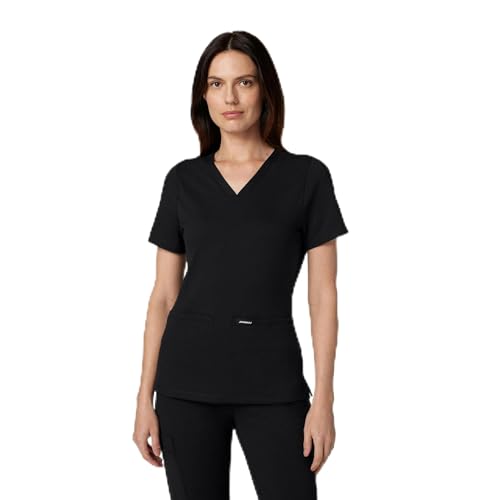
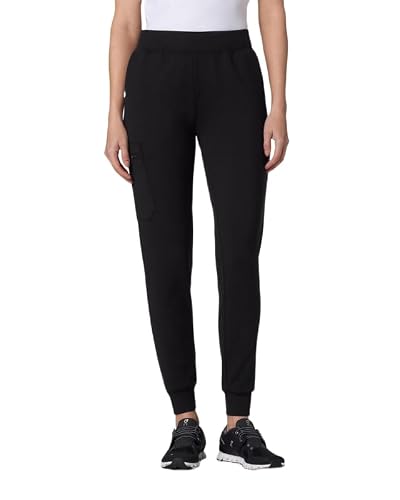
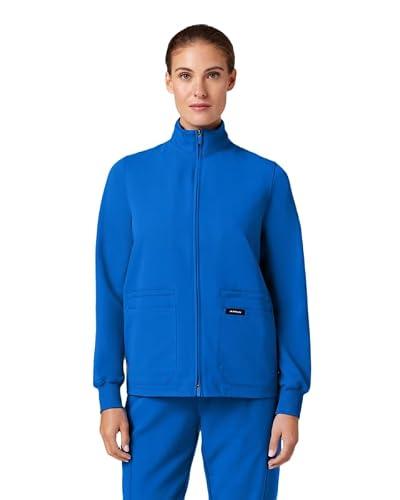
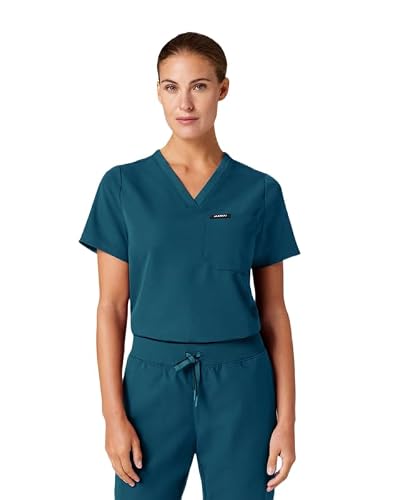
Jaanuu sits in the premium tier with FIGS, costs roughly double the mid-market brands, and gets recommended mostly on feel - which is the least checkable claim in this category. So this review does the checkable thing instead: it reads what the brand publishes. On its tops, Jaanuu publishes more than almost anyone - composition to the percent and a fabric weight in oz/yd2. On its pants and jackets, it publishes neither. That asymmetry is the most useful fact about the brand, and it decides which Jaanuu garments are worth buying.
Nobody here has worn any of it. We are a research site and say so on every page, so what follows is specification, disclosure and the trade-offs those imply - not a wear test.
The verdict, and who it is for
Buy a Jaanuu top if you know which of the two fabrics you want and you are not relying on pockets. The Rhena at 6 oz/yd2 is genuinely the answer for a warm unit; the Cesi at 9.7 oz/yd2 is genuinely the answer if you want softness and opacity and you wash your own scrubs. Both are published figures, which is more than most brands will tell you.
Be more skeptical about the pants and jackets. They are probably fine garments. They are also sold at a premium price with no published fiber content, by a brand that clearly knows how to publish fiber content, and that is a reasonable thing to decline.
And do not buy any of it if your employer launders your scrubs. That rules out the Cesi outright and makes the rest a gamble, for reasons the laundry section below gets into.
Two fabrics that are near opposites
Most brands have one fabric story. Jaanuu has two, and they point in opposite directions:
| Published specification | Rhena (Essential) | Cesi (UltraSOFT) |
|---|
| Composition | 76% polyester, 18% rayon, 6% spandex | 65% rayon, 30% nylon, 5% spandex |
| Fabric weight | 6 oz/yd2 | 9.7 oz/yd2 |
| Pockets | One left chest | Two welt, side vents |
| Fit | Tailored, tuckable, back darts, side vents | Slim |
| Treatment | Silvadur antimicrobial | Silvadur antimicrobial |
| Published sizes | XXS to 3XL | XXS to 3XL on the retailer listings located |
A 6 oz/yd2 fabric and a 9.7 oz/yd2 fabric are not two versions of the same thing. That is roughly a 60% difference in mass, and it is the difference between a top that disappears on a warm unit and one that insulates. Buying "a Jaanuu top" without choosing between them is how people end up disappointed by a brand they paid a premium for.
The rayon content runs the same way and matters more for how long the garment lasts. 18% rayon survives repeated washing considerably better than 65%, which is also why the softer one is the more fragile one. If you want the softness argument made properly across brands, the stretch roundup covers what elastane and rayon each do and in what order they fail.
One pocket is a real decision, not a detail
The Rhena has a single left chest pocket. In a category where the mid-market standard is three to five pockets and WonderWink builds tops with more, that is the defining limitation of the garment - and it is a deliberate one, because patch pockets are what break a tailored line.
If you carry a phone, a penlight, shears, tape and a report sheet, this top does not work and no amount of liking the fabric fixes it. The honest routes around it are a scrub jacket with real pocket count, a pocket organizer, or a different top. Two of those three mean spending more on top of a premium purchase.
The Cesi's two welt pockets are better but not a solution either - welt pockets are shallower than patch pockets and they spill when you bend over a bed. The pockets roundup is the page to start from if carrying capacity is your first criterion rather than your third.
What Silvadur is, and what it is not
Both tops carry a Silvadur antimicrobial treatment, and the listings say so plainly. Here is the part the marketing leaves implicit: an antimicrobial textile treatment is an odor and garment-life claim, not personal protective equipment. It is there to stop the fabric smelling and to slow fabric degradation. It does not protect you from pathogens and it does not protect your patients from anything you are carrying.
This is not a Jaanuu-specific criticism - Cherokee's own disclaimer on the equivalent treatment says the same thing explicitly, which is why our Cherokee review calls that brand the most honest in this registry. It does mean you should not pay extra for the treatment as a safety feature. The antimicrobial page sets out what the treatments do and do not do across every brand here.
The disclosure gap, and why we are making a point of it
Jaanuu publishes composition percentages and a fabric weight for the Rhena and the Cesi. For the Rubi joggers and the Ceri jacket, the listings we could locate give a fabric line name - UltraSOFT, Essential - plus property claims like all-around stretch, moisture control and fade resistance, and no percentages at all.
Why that matters practically: composition is how you predict laundering. A pant that is mostly polyester tolerates a hot wash; a pant that is mostly rayon does not. Without the numbers you cannot tell which you bought until after you have washed it, and at this price point that is a risk you are being asked to absorb for no reason - the brand demonstrably has the data.
We record disagreements and gaps like this on where the published specs disagree rather than quietly filling them in with a plausible number.
Laundry decides whether this brand works for you
This is the first question for any premium scrub and the last word on the Cesi. A 65% rayon blend needs home washing on a gentle cycle. Hospital industrial laundry runs hot, with a chemical cycle, at volume - it will not return a rayon-heavy garment in the shape you sent it.
If your employer launders your scrubs, buy poly-spandex and spend the difference on more of them. If you launder your own, the Rhena's 18% rayon is the safer premium choice and the Cesi is the indulgence that needs looking after. How to wash scrubs covers where the care label and infection-control advice actually conflict, which is a real tension rather than a tidy answer.
Fit and sizing
Jaanuu publishes XXS to 3XL on the tops, which is wider at the small end than most brands and narrower at the large end than Dickies, whose EDS Signature collection runs to 5XL. Retailer listings differ slightly on the range - one authorized retailer describes its women's range as XS to 3XL while others list XXS - so check the specific listing rather than the brand page.
Both tops are cut close: the Rhena is tailored and tuckable with back darts, the Cesi is slim. Neither is a forgiving fit, and the Rhena's tuckability is a real feature if your unit expects a tucked top. If standard sizing does not work for your proportions, petite and tall and curvy and plus-size are the pages that sort brands by what they actually publish about cut.
Alternatives worth considering
If you want the premium hand-feel but more pockets: FIGS, whose Zamora jogger and Yola pant carry far higher pocket counts. FIGS against Jaanuu is the direct comparison, and the FIGS review reads that brand's disclosure the same way this page reads Jaanuu's.
If your scrubs are industrially laundered: a poly-spandex mid-market top. Cherokee against Dickies is the decision most people in that position are actually making, and both cost a fraction of this.
If carrying capacity comes first: WonderWink, and WonderWink against FIGS frames the premium-versus- utility trade without the brand loyalty.
If you simply want the shortlist: the brand comparison ranks every brand here on what it publishes rather than on how it photographs.