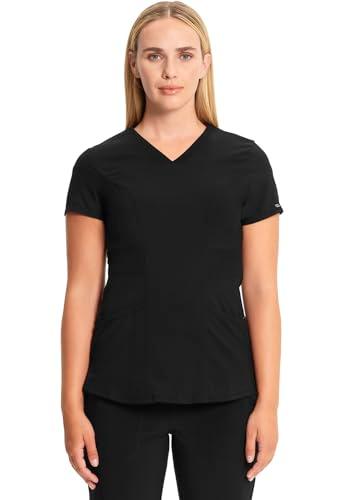
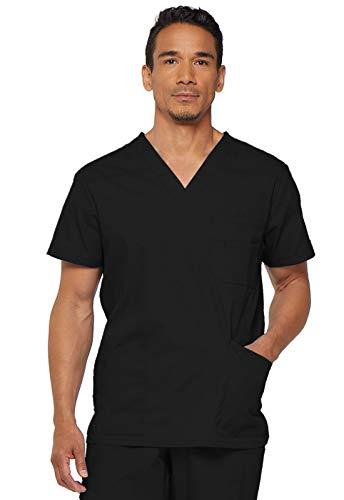
These two brands occupy the same shelf at roughly the same price, and the internet mostly compares them on how they feel. That is the least decidable thing about them. What is decidable is the fiber: Cherokee Infinity is a 95/5 poly-spandex poplin and Dickies EDS Signature is a brushed 55% cotton blend, and almost every practical difference below follows from that one line.
The question that settles it: who washes them?
If your employer launders your scrubs, buy Cherokee. Institutional laundry means high temperatures, a chemical cycle and volume, and cotton responds to that by shrinking and wearing out faster than polyester does. There is no technique that gets you around it.
If you wash your own, the question re-opens and cotton becomes a legitimate choice - you control the temperature, and the trade you are making is wrinkles and drying time for how the garment feels against you on a warm unit. That is a real trade rather than a wrong answer.
The complication nobody mentions: home-laundering clinical clothing has its own guidance, and it does not always agree with the care label on the garment. How to wash scrubs lays out where those two conflict - because a 60 C wash is what the infection-control advice points at and what the cotton garment likes least.
Side by side, on published figures only
| Published specification | Cherokee Infinity | Dickies EDS Signature |
|---|
| Fabric | 95% polyester / 5% spandex poplin; rib trim 96/4 | Brushed 55% cotton / 45% polyester poplin |
| Stretch mechanism | Elastane in the fabric - four-way stretch | Rib-knit side panels and neckline insets; no elastane stated |
| Fabric weight | Not published | Not published |
| Antimicrobial | Certainty, stated to last beyond 50 washings | None stated anywhere on the collection |
| Published size range | Standard range on the listings located | XXS to 5XL across the collection |
| Pockets | Two front with pen slots in both, interior pocket on the right | Varies by style - 3-pocket core V-neck up to 5-pocket shaped V-neck |
| Published garment length | Not published on the listings located | 26 in center back on the DK880 women’s V-neck |
| Stated properties | Four-way stretch, moisture wicking, wrinkle resistant | Contemporary fit; brushed hand-feel |
| Fluid-barrier rating | None stated | None stated |
| List price | Mid-market | The cheaper of the two at list |
No price is typed into this page - a number typed in November is wrong by February - so every number sits inside a buy button, read from Amazon’s API on the date shown. The stable fact is the ordering: both are a fraction of the premium brands, and Dickies is the cheaper of the two.
Two different ways to build stretch, and they fail differently
Cherokee puts 5% spandex in the fabric, so the whole garment gives in every direction. Dickies uses rib-knit panels at the sides and neckline and states no elastane at all, so the give is located where the panels are.
Cherokee’s approach is better on day one - four-way stretch across the entire top is more comfortable than stretch in two panels. Dickies’ approach may be better in year two, because elastane is the fiber that degrades first: it is what makes an old stretch top go baggy and stop recovering. A rib-knit panel is still a rib-knit panel after fifty washes.
Neither brand publishes any durability figure for this, so that is a materials-behavior read rather than a measured claim and we are labeling it as such. What we can say for certain is that the Cherokee fabric has a component the Dickies one does not, and that component has a known failure mode.
The antimicrobial claim: real, and narrower than it sounds
Cherokee publishes something unusual here - a durability figure. Its listings state the antimicrobial fabric protection lasts beyond 50 washings, which is a checkable number in a category full of unquantified treatments. Dickies states no antimicrobial treatment on the EDS Signature collection at all.
Before you read that as a win, read Cherokee’s own disclaimer, which is explicit that the treatment does not protect the wearer or others from bacteria or viruses. It is an odor and garment-life claim. That makes it worth something - scrubs that smell less at hour eleven are worth something - and worth nothing at all as protection.
Cherokee being that explicit is also why our Cherokee review calls it the most honest brand in this registry. The antimicrobial page covers what every treatment here does and does not do.
Both of these tops are also cheap enough to buy several of, which changes the question from “which one” to “how many.” The best scrubs under $30 puts them next to the WonderWink line and ranks the whole bracket on cost per wear.
Sizing: Dickies, clearly
XXS to 5XL across a collection is the widest published range on this site, and it is the single most decisive advantage either brand has. If you wear above a 3XL, this comparison is already over - the premium brands stop at 3XL and most mid-market ranges stop before 5XL.
Dickies also publishes a center back length, which is a genuine rarity and useful if top length is what usually goes wrong for you. The catch is that pocket count is not a collection-wide figure: Dickies’ own style names run from a 3-pocket core V-neck to a 5-pocket shaped V-neck, so you have to check the individual style rather than trusting the brand.
If fit is your primary constraint, curvy and plus-size and petite and tall sort every brand here by what it actually publishes about cut rather than by what the photos suggest.
What neither of them publishes
Fabric weight. Neither brand gives an oz/yd2 figure, which means how opaque a given color is stays a guess until the garment arrives. The premium brands do publish this - the Jaanuu tops in our Jaanuu review are 6 and 9.7 oz/yd2 - and it is the clearest thing mid-market brands could start disclosing.
Any fluid-barrier level. No AAMI rating appears on either. These are uniforms, not protective equipment, and anything requiring a barrier is a different garment entirely.
Composition on every item. Cherokee publishes fabric on the Infinity top and not on the jacket listings we could find. Both brands are inconsistent item to item, which is why we judge garments rather than brands.
A stable style number. This one is worth planning around. Dickies style numbers churn - the DK880 now reads as no longer available at some retailers while the collection continues - and the brand’s own storefront at dickiesmedical.com currently redirects to a retailer. If you find a colorway and fit you like, buy more than one, because the exact style may not be there next year.
Who should buy which
Your employer launders your scrubs. Cherokee. Not close.
You wear above a 3XL. Dickies, which publishes to 5XL.
Your unit runs warm and you wash your own. Dickies, for the 55% cotton.
You need to come out of a locker uncreased. Cherokee - wrinkle resistance is a stated property, and cotton creases.
You want the most stretch, everywhere. Cherokee’s four-way stretch across the whole fabric, not two rib panels.
You want the top that still recovers its shape in two years. Dickies, on the materials reasoning above rather than on a published figure - no elastane means nothing for the laundry to destroy first.
You carry a phone in your top. Cherokee, which publishes an interior phone-sized pocket on the right rather than implying one.
You want five tops for the price of two premium ones. Either, and that is the real argument for shopping in this tier at all - the twelve-hour roundup makes the case that owning more scrubs beats owning better ones.